Two poems

An Old House on Main

On the corner of Main Street
stood a house that belonged
to the new arrivals, illegals
the locals called them, whose
delight swallowed a weathered
building reeking with staleness
and the stares of strangers
longing for something more,
but unknown. The soberness
of its quaint doors burned forlornly,
its colors betraying like a passion
of flames refusing to be fanned.

It was not the house you dreamt
of before you left your paradise
in Accra but it welcomed your tired feet
and sheltered you from the rage
of the angry weather. This house
welcomed the dreams you brought
to be born in a new world
that doesn’t see you, hoping
you might find in it a second home
that reminds you of a house
beyond the Atlantic, beyond the
house of history’s angel whose gaze
is in the past, whose music is
to the dance of ruins and empty time.
This house, a pile of debris that
becomes both a storm and a farce,
is progress for those vanquished
by power.

.


Hope

The sapphire
of hope—

that brightens where
Romanesque catacombs

entrap the soul
like a spell—

brings echoes
of a certain paradise,

the Elysian fields
of dreams,

no longer deferred.
No longer buried,

only permitting light
that shines through
the tree of life.

Rare books and the stories they tell

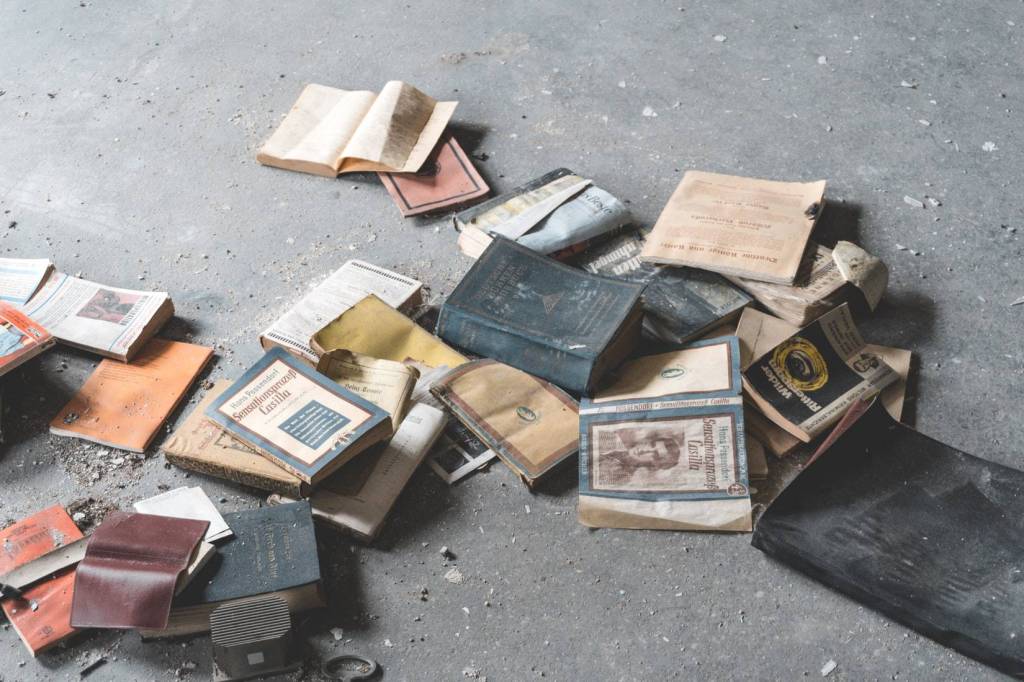
When literary scholar, Nathan Suhr-Sytsma recently posted on Twitter that he had inherited a “legendary poetry anthology, edited by the much-missed Harry Garuba and published in 1988,” it occurred to me that this bequest, if we may call it that, was a rare book I may never find in Lagos, the original home of Malthouse Press Nigeria, the publishers of the anthology. But what actually makes a book rare? Or when does a book become an object of rarity? In a Nigerian context, it is definitely not only a question of its oldness, although that is important. More crucially, the cultural politics of knowledge production invites us to understand how books are not only made rare, absent, and inaccessible, but also figure into the crises of education in the country.

Collectors and librarians often speak of rare books as distinctive texts that are deemed to have a special value because of their limited supply, age, or historical significance. The first edition of Achebe Things Fall Apart, for instance, might be understood in this sense. While there are countless editions of the classic anti-colonial novel, to find the first edition would be truly special, even if many fail to appreciate such sentiments. When the Nigerian writer Lola Shoneyin invited book-collectors on Twitter to buy her friend’s “first print, first edition of #ThingsFallApart for N1m,” several followers and readers online were bemused by the monetary value the book commanded.

The distinction of this rare copy may not be in the sense of the original manuscript of the novel in Achebe’s handwriting, but that does not even come close to diminishing its unique quality. Well documented already are Achebe’s adventures with the initial manuscript of his acclaimed novel, as well as his experience of losing, and later recovering the untyped manuscript after the intervention of his colleague at the Nigerian radio service, Angela Beattie. I wish I could say that “manuscript—handwritten, by the way, and the only copy in the whole world” then is now somewhere in the special collections at the University of Ibadan.

If it still exists today, it may probably be in the special collections of some library in the US or in the UK. While the physical and aesthetic features of this particular first print, which Shoneyin advertised and later found a buyer for, are sufficient reasons for those Twitter followers to reconsider their dismissive stance, this copy is also the closest to the original and has probably gathered dust, memories, and meanings which have become tattooed on its material identity. You should read Kọ́lá Túbọ̀sún’s reflection on book collecting to get a sense of how people develop an attachment to physical books as objects connected to memories, narratives, and spaces.

We hardly think of books as material objects with physical and para-textual characteristics that shape the stories they convey. Hence, as a rare book, Heinemann’s first print issue of Achebe’s novel came with a specific cover, front matter, paper type and page numbers that are different from other editions produced later. These variations, which are usually the research delights of a bibliographical scholar or textual critic, may become central for narrative discovery. But the scholarly possibilities of rare first editions and other priceless printed works aside, I do believe rare books tell other stories, and this is the crux of my Achebe digression on the rarity of print and literary publishing, a topic Suhr-Sytsma actually under the rubric of the extroverted African novel and literary publishing in Nigeria.

Photo credits: Nathan Suhr-Sytsma

Rare books offer us tales that evoke our relationship with knowledge and the cultural politics that undermine it in a country like Nigeria. If we assume for a moment that a copy of a 1988 anthology by Nigeria’s foremost writer community can only be found in Atlanta or London, rather than in a special collections in Ibadan or Lagos, then it speaks to something of our own valuation of the knowledge we create. That is one major story rare books in Nigeria tell. A book is not rare because its market value is huge; it is rare because its existence in a local library is precarious or it can only be found in locations external to Nigeria.

We routinely point to the economic disparities between the Global North and the Global South as some of the possible reasons for this, but is it not the case that there are African countries where the archive and the public library are truly functional spaces? Aside from Botswana, South Africa, and a couple of countries in the Maghreb, Senegal and a few others also boast of a sturdy intellectual tradition, having public spaces of knowledge that are accorded the veneration they deserve. With a messy educational sector in Nigeria, it is reasonable to conclude books, maps, manuscripts, and other rare artifacts or document of African thought are not as well preserved as they need to for the pursuits of knowledge for its own sake.  

The rarity of that Garuba anthology is, then, one chief indication of the historical neglect of education in countries like Nigeria where decades of prebendal politics have undermined epistemic spaces and infrastructures. Strikes and boycotts by professors may be the most popular, albeit passé, means of pressing the government to fund education, but the state of books, their conditions of production and circulation, their absences in libraries as well as their presence or not in our country also echo what has become a precarious entanglement with knowledge.  Rare books in Nigeria are the inventions of a political class that underplays education. The rarity of books must therefore be encountered as an invention of weak democracies, besides the material aesthetics and historical value they possess.

Rare books also suggest a certain limited presence of books that anchor our institutions of learning; it is not that you will never find signed copies, handwritten manuscripts, first print issues, and precious government papers in Nigeria; on the other hand, their presence and the information they contain are shaped by the crumbling shelves of underfunded public libraries and archives.

But the presence of Nigeria’s rare books must sometimes reach us when we become absent from our country. Of course, there is still much to be mined for research in public knowledge environments in Nigeria, and many scholars who appear to treasure those collections more than we do routinely travel from the Global North to different archival locations on the continent to access these materials; yet, for now, it is as if, barring very few interventions in digital publishing, we must always leave Nigeria to encounter the most sophisticated ideas produced about Nigeria. This is not to suggest you can’t find cultural institutions that value rare and historical materials in Nigeria. The Centre for Black Culture and International Understanding at Osogbo is one of several places where it is possible to see well-documented historical publications.

So, what makes it possible for books once published and available in Nigeria to become absent and rare there while easily accessible abroad? This is not always a question of income differentials between Africa and the west. One way to think about this is, returning to Achebe, to ask if any single library in Nigeria has all the currently existing editions of his famous novel. What is stake in such a question is one that tackles the structural conditions that generate the rarity of books in Nigeria.

Two common narratives about the archive of African knowledge systems which are often expressed in intellectual circles on the continent and its diaspora are relevant here too. They are based on orality, and the state of print publishing in Africa studies. You have probably heard that common dictum of oral culture sometimes attributed to the Malian, Amadou Hampâté Bâ: “In Africa, when an old man dies, a library burns down.” In the winter of 1960, Bâ rendered a similar line as head of Mali’s delegation at a UNESCO General Conference: “I consider the death of each of these traditionalists as the burning of an unexploited cultural fund.” This sweltering vision of a library that actually burns, unfortunately, was to be seen in the recent Table Mountain fire at the University of Cape Town.

Its attendant ruination of rare books and other print artifacts on African literatures and history remains hauntingly fresh in the memory of many scholars working in South Africa and indeed around the world. In this case, our tragic ashes of knowledge are not constitutive of the destruction of any oral library embodied by griots and elders committed to our ways of knowing; it is the irreplaceable loss of historical materials, manuscripts, and government records.

The second narrative centers on the often-lamented inability of colleagues and researchers in Africa to access the newest books published about the continent from the Global North usually because of huge costs. Infrastructures of knowledge, perennially anchored on weak systems because of lack of funding has historically created conditions in which books written about Africa are constantly produced elsewhere.

It has become a pastime in recent years for the Africa’s diaspora class of intellectuals to lament the inaccessibility of their publications on the African continent. While this is beginning to change, it has meant that the archive of African epistemic forms have always been a migrant and extrovertedly oriented location that is historically tied to colonial politics and the institutional knowledge spaces colonialism created to normalize and legitimize its hegemony.  In recent years, though, there have been several initiatives to make books about Africans accessible on the continent. One prominent example of this is the African Books Collective (ABC), a worldwide marketing and distribution outlet for books from Africa.

Specializing in scholarly, literature and children’s books, the collective also profiles the work of African publishers and books through its Read African Books initiative. With platforms such as this, it is much more effortless to document our relations with books, build digital spaces to remediate extant materials, and turn a preservationist gaze towards those that become or are made rare by the politics of our indifference to knowledge.

The argument can be made that the real issue here is about the complexities and instabilities of print cultures in Africa and how different groups and individuals initially in different African cities responded to colonial modernity and used newspaper cultures, for example, for their nationalist struggles Scholars like Karin Barber, Stephanie Newell, and Rebecca Jones have important contributions on this topic.

But, again, the question persists: what conditions make, for instance, copies of literary pamphlets in the famous Onitsha Market tradition accessible in Kansas or Florida, but not in Nsukka? If we aren’t able to locate similar texts preserved in good conditions in local libraries in Lagos or Accra, it probably suggests something of a misrecognition of their true value. For materials printed by local presses between the late 1950s and 1970s to be made rare because of our austere relationship with knowledge suggests it’s time to get beyond colonial legacies and the coloniality of postcolonial existence which are sometimes seen as singularly dictating the rarity of epistemic forms.

Books become rare in Nigeria because of other social and cultural attitudes to knowledge itself. Even popular narratives in music, Nollywood films, and even from university campuses sometimes betray our belittling of books and rare books. Not that we don’t think they are important; they are just a means to a materialist end of, and if other alternatives exist, why bother? The history of rare books may be deeply connected to the history of the printed book itself, but their meanings in some African countries become articulated with social, cultural, and political structures that sometimes sideline their value. And a continually diminished African agency remains the most obvious sign of this entanglement.

The real story of Dr. Suhr-Sytsma’s rare inheritance posted on Twitter is how it also comes to symbolize another reminder of the migrant archives of African knowledges. But since I would be remiss to suggest that it is the fault of non-Nigerian scholars abroad to be in possession of Nigeria’s rare books, I do need to recognize the fact that the tweet of a rare ANA anthology in the US also invites the rest of us to do more with the private collections of a much earlier generation of Nigerian book collectors. I am sure I am not the only one whose grandfather valued books. Many of us, as Túbọ̀sún’s journal also indicates, fondly remember the roadside sellers of rare books of our childhood as well as the personal libraries and collections of our parents and grandparents in Lokoja, Bodija, Makurdi and elsewhere. Perhaps it’s time to visit home again. There might be rare treasures waiting for us.


Where the Baedeker Leads: Interview with Uche Umezurike

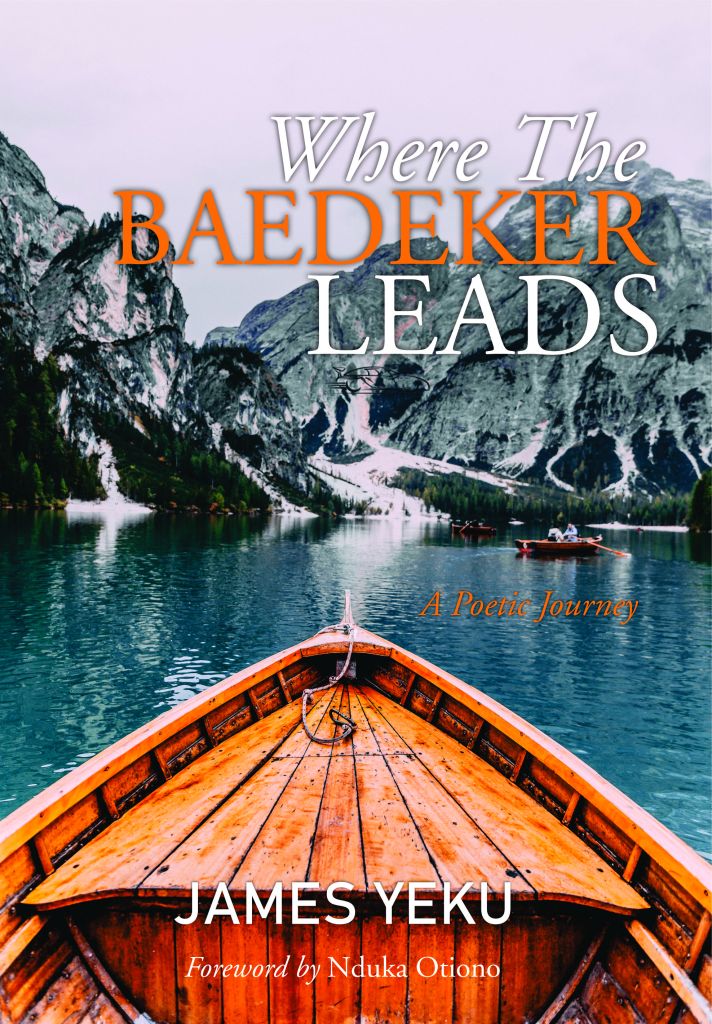
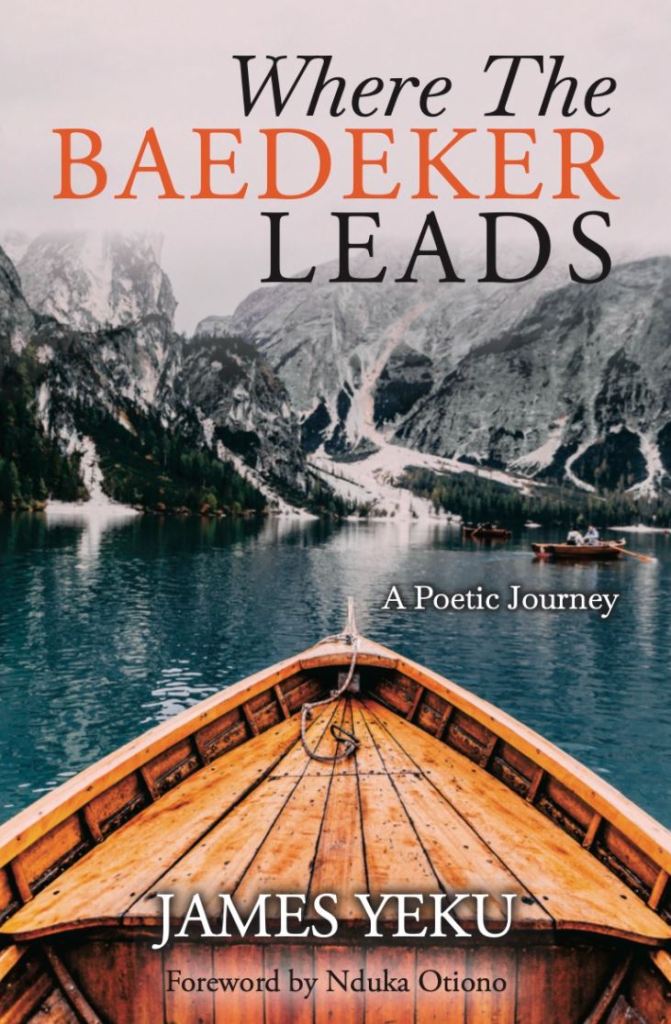
In Where the Baedeker Leads, James Yékú explores in language precise and mellifluous the particulars of longing and love, home and diaspora. He takes the reader along routes of memory and immediacy, traversing time and space, mapping geographies far and wide—geographies of belonging, intimacy, loss, and alienation—all the while revealing what connects, what severs, what roots, and even uproots us—whether we live in Africa or North America, or elsewhere. Yékú finely weaves the personal and the political in this debut poetry collection. 


Uche Umezurike: Where the Baedeker Leads touches upon home, migration, diaspora, and identity. It also considers intimacy, sensuality, and love. What drew you to these themes? And what insights did you get while writing your book

James Yékú: This is a great question, and I am glad you raise it. Actually, those themes took on a life of their own as the collection grew and matured over a ten-year period. But the poems that speak to conditions of exile, migration, and diaspora were the means by which I sought to make sense of life in North America—first and mostly in Canada, and later in the US where I live in Lawrence, the former home of the American poet Langston Hughes, a major leader of the Harlem Renaissance. Of course, the migration poems can be plugged into a long tradition of literary sensibilities that cater to the estrangement and hardships of a life elsewhere, but I like to imagine them as an archive of my own journey through seasons and spaces. The intimacies of these times and places are worked into the poems that grapple with love and sexuality.

Please read the rest of the interview at PRISM international, Vancouver-based journal of contemporary writing from Canada and the world.

England’s Racial Scapegoating and the Burden of an Apology

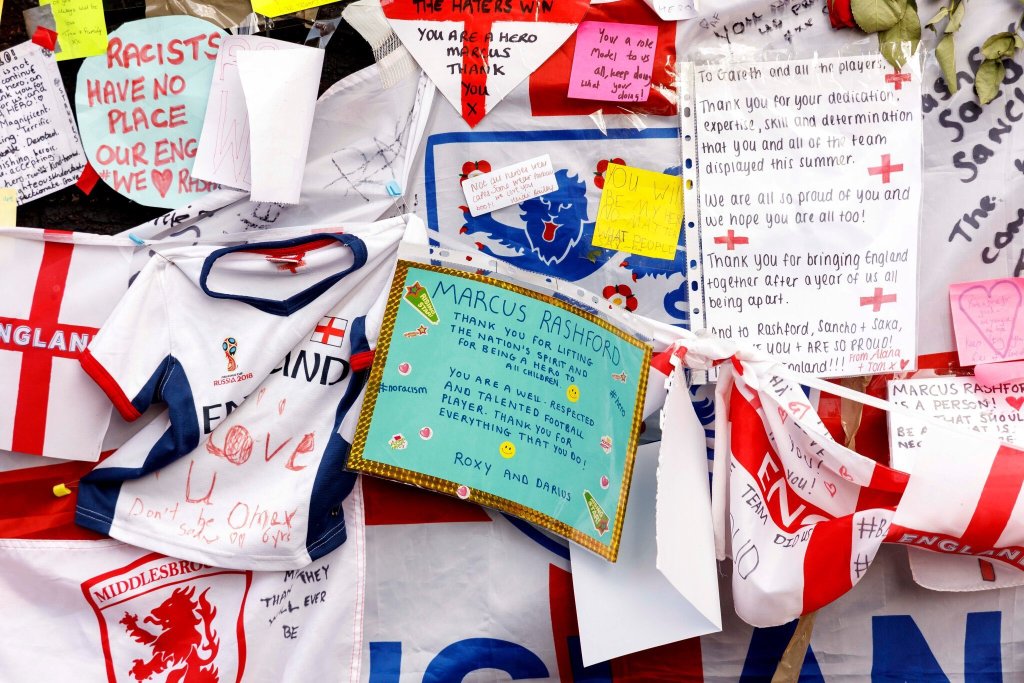
As Gareth Southgate gave instructions to Manchester United forwards Jordan Sancho and Marcus Rashford on the touchlines in the 120th minute of the Euro 2020 final against Italy last Sunday, the first thought I had was how the coach’s substitutions signaled his tactical readings of a game headed for a penalty shootout. In a match in which England had been, for the most part, content to sit back and absorb the endlessly mounting pressures of the Azzurris, subbing in more offensive players, after the likes of Jack Grealish and Bukayo Saka, seemed like a logical thing to do, especially with the score tied at 1-1.

But I did actually fear for Sancho and Rashford as I saw them coming on, given my hunch and prediction on Twitter that any talk of home was in the direction of Rome. As the lads made their way to the pitch mainly for the penalty kicks as it were, I could not shake off the feeling that some very vile people on the Internet, and indeed, a section of the English media, might soon be descending on them.

And with Arsenal’s Saka and the two United players all missing their penalties, my fears were confirmed as Italy replaced Portugal as European champions, winning the title with a 3-2 shootout victory. What followed England’s defeat was a predictable torrent of disgusting and racist behavior, particularly on social media, and by fans who subjected the three Black players to a recognizable history of their country’s racial scapegoating.

This racist abuse that trailed Sunday’s final actually harkens back to years of discriminatory attitudes towards Black footballers in the UK. The fact that Black footballers become singled out for unmerited blame and consequent negative treatment despite their team’s collective performance points to larger and perennial issues of race and culture that have remained, sadly, sedimented in the UK. Race remains messy and often explained away as a performance of victimhood or even discounted by politicians—as in the case of the initial indifference of Boris Johnson when fans booed players for taking a knee earlier in the tournament.

Credits: Marcus Rashford. Twitter

Although Johnson thought this particular England team deserves “to be lauded as heroes, not racially abused,” his condemnation of racism is seen as hypocritical and orchestrating the toxic atmosphere that informs prejudice online. To be selective or merely performative in our denunciation of racism, or silent when players are unjustly called out for enacting symbolic rituals of resistance—like taking a knee is to undermine anti-racist work and condemn English football to its current shambles of identity politics.

Of course, people don’t become racist simply by opposing a strategy adopted by self-proclaimed anti-racists. Wilfred Zaha of Crystal Palace, for instance, has previously refused to take a knee, claiming kneeling has just become a part of the pre-match routine that doesn’t change the persistence of racism. Similar to some military veterans of all colors who have refused to take a knee in the US, Zaha cannot be truly considered racist. But for politicians like Boris, I think anti-racist expectations are ought to be a necessary given.

Sunday’s fallout from the Euro painfully gestured back to Cyrille Regis’s debut about four decades ago, to the 2008 flood of antisemitic emails received by manager, Avram Grant shortly after his appointment by Chelsea, and even to the structural conditions that produce the paltry number of Black football coaches in England.  With only about 7 black or non-white head coaches in the top 92 clubs in the English professional leagues, there is definitely a systemic dimension to the factors that limit opportunities for Black sportsmen and generate offensive behavior. Football, as it were, remains a discursive portal into the soul of the English society. Despite its proverbial status as the beautiful game, it embeds a lingering ugliness that is at once traumatic and indicative of what still needs to be done for a more just society and footballing future.

With social media, ambivalently reputed for its depoliticizing logic and amplification of voices, the intensities of online racism against Black footballers become even more endemic. A certain personalization of fandom on social media means players sometimes are easily accessed by fans of different backgrounds and ideologies, including those with ingrained bigotry and chauvinistic sensibilities. An avid social media user himself, Marcus Rashford is undoubtedly familiar with how the platform easily lends itself to harassment. After a 0-0 draw at Arsenal in January, Rashford received racist messages online but refused to take screenshots as it would be “irresponsible” to do so. But the 23-year-old did describe the whole episode as “humanity and social media at its worst.” How apt!

Not even a social media boycott to fight racism by English soccer players some weeks ago has changed anything. Hence, the calls continue to mount, and rightly so, for government to compel social media companies to have more regulatory frameworks for hate speech. But in the light of other deep-rooted problems of racism in society, looking only to social media is mere rhetoric for inaction. But more important is that reliance on tech companies to firm up hate speech protections seems counter-productive, even if it sounds natural. It appears we are surrendering agency to tech companies and asking them to solve cultural problems that society itself has found intractable. This is problematic, reinforces platform power and undermines our complaint that social media companies are too powerful since we still expect them to mobilize that power in addressing hate speech. Rather this ironic surrender, we could do more, including the kinds of actual arrests made by the UK Football Policing Unit.

I have written previously about the implicit prejudice that often surfaces in Western media discussions of Black and African players and the ways in which the language of football commentary confirms the latent bigotry that haunts football. This latest post-match racism follows a similar model; only that in this case, the media is populated by everyday people whose offensive clapback on social media often draws heavily from the unprofessional punditry of media commentators and indeed from indifferent politicians.

Rashford is again, back on social media, after the latest iteration of this inhumane treatment, as well as the vandalization of a mural honoring him in Withington, Manchester. That the mural itself has become some kind of symbolic space that performs positive fandom and racial solidarity might suggest there is reason for optimism, but more needs to happen in response to structural racism. And although Rashford expressed regret for his missed penalty, he was clear about not being apologetic about his blackness and identity. In a very moving conclusion to his statement on Twitter, he says: “I am Marcus Rashford, 23-year-old, black man from Withington and Wytheshawe, South Manchester. If I have nothing else, I have that.” This powerful message on Twitter has received the necessary support from FA officials, other soccer players and groups, as well as numerous fans from around the world and, yes, from England.

Again, there are millions of English people for whom racism is not a problem and one must abjure the passions of blind essentialism. That said, I really do wonder if we hold white players to the same standards of penance we sometimes expect of players of color. True, most footballers apologize when they sense they have left their fans down, but the circumstances that surround the apologies of Black players sometimes conjure up other politics and provincialist sentiments. You may find here Jordan Sancho’s apology on Twitter to get a sense of the unnecessary pathos of this selective politics.

Clearly, Rashford’s message, along with Jordan’s and Bukayo Saka’s, points to the very conditions that set up our understanding of white privilege and the burden of an apology that stands on the shoulder of Black footballers whenever they perform below expectations on the pitch. There are nonpologies, but there are also unnecessary apologies that tend towards trauma, apologies whose underlying message signals our unwilling capitulation to a dominant cultural system.

It is nothing but mindless utilitarianism to construct Black players as humans only when they are deemed useful and usable in the public space. It should be troubling that the margin for error afforded to their peers is far greater than what Black footballers enjoy. This should not be normalized in an age in which the depathologization of racial identities means something to all progressive societies 

#TwitterBan and the Techno-Politics of VPNs

Before the Nigerian state announced its Twitter ban on Friday, June 4, 2021, it was commonplace among internet users disenchanted by Nigerian economic conditions to speak of migrating to countries in the Global North. Canada became the most mythologized of these Western locations in internet discourses, becoming the subject of many a meme and comic social media post. Of course, for the mostly middle-class Nigerian population that is online, there exists the material reality of limited means to actually leave the country, with Canada and elsewhere lingering forever as a dream deferred. Until Nigeria decided to indefinitely ban Twitter.

With Twitter’s deplatforming of Donald Trump very much in the global media memory, the ban came after the social media company deleted a tweet from the Nigerian president’s account for violating its rules. In its official statement banning the company—itself posted on Twitter—the Nigerian government pointed to “the persistent use of the platform for activities that are capable of undermining Nigeria’s corporate existence.” Twitter, in the words of the country’s information minister, is essentially “the platform of choice to destabilize Nigerians,” a reference to Biafran seperatist politics. The “persistent use” argument became a reason for the violation of the online free speech of many Nigerians, an effect which also prompted the EU, US, and Canada to voice concerns over the decision.

Photo: Petter Lagson

That said, virtual private networks, or VPNs, have helped many Twitter users to circumvent what the government later termed “a temporary” suspension of the tech giant. This highlights the political dimensions and potentials of digital technologies, especially in a Nigerian context with some of the most active social media users in Africa. The techno-politics of the VPN means that activists and other netizens who express their views on Twitter, Facebook, and other public platforms can conceal their IP addresses—which would otherwise make them locatable—behind those of their VPN servers. Meanwhile, internet service providers are left in the dark about users’ actual internet activities and locations. While VPNs offer immediate solutions to a government-regulated internet, they also happen to make the dreams of travel possible for many would-be immigrants. As people physically present in Nigeria excitedly share tweets ostensibly from Canada, Germany, and other parts of the world, they are finally able to realize their dreams of leaving Nigeria behind. Well, at least metaphorically.  

Metaphors aside, there are real-world consequences to the resistance politics of the VPN. As the Nigerian government threatens to persecute digital subjects who bypass censorship and government-controlled internet networks, it recalls the state’s previous efforts to limit the purported spread of misinformation online. While fake news and misinformation are rife in Nigeria as elsewhere, this specific reason is actually an ideological façade for the government’s perennial, compulsive desire to regulate social media more generally. Never mind that the Buhari administration is notorious for what is regarded by many as a digital propaganda arm, the Buhari Media Centre (BMC) which is charged specifically to spread disinformation online.

The control of social media is why the Nigerian government reached out to the Cyberspace Administration of China to discuss plans to build an internet firewall. Like the popular Great Firewall of China, a separate Nigerian internet would give the government unfettered control over social media platforms—but there are even more disturbing implications. The alliance with China makes more legible the authoritarian dimensions of Nigeria’s president, Muhammadu Buhari, a former military dictator whose human rights record is less than stellar. Anyone who cares about civil society, free speech, and human rights must find the state’s digital silencing of its citizens worrisome. If the state succeeds in building firewalls and disrupting the protection that VPNs offer its netizens, future protests, both online and on the streets, will no doubt be different and potentially violent. 

This is aside from curtailing the gains made in a country where about half of the population are still digitally disconnected. Besides the fact that the internet is a great tool for political mobilization and participation in Nigeria, it is also an important space for cultural netizenship, that is, the comedic and artistic use of memes, cartoons, and other web images to circulate political and cultural perspectives online. Even more crucial are the entrepreneurial possibilities of digital citizenship. In a country with limited youth employment, governmental control of digital platforms potentially imperils a large number of innovative young people who rely on the internet to confront their economic precarity. As of January 2021, there were 104.4 million internet users in Nigeria; the country’s internet users increased by 19 million (+22%) between 2020 and 2021. The Twitter ban, the drive to block VPNs, and the efforts to further regulate Nigeria’s digital ecosystems more broadly will inevitably limit many of these users and the economic agency they find online.

To be clear, VPNs have always been central to global politics of resistance in the age of the internet. Moreover, in recent years, we have seen the intense politicization of these networks, from Hong Kong to Myanmar and now Nigeria. For instance, the private networks are the infrastructural basis for the deliberate subversion of government’s threat to punish anyone who breaks the Twitter ban law—which, frankly, is not constitutional. Many not only used VPN to continue the business of tweeting as usual, but have been mentioning government officials, public figures and politicians in tweets, while calling out government agencies who remained on the platform.

The political dimensions to VPNs also include how the networks made legible the marginality of oppressed communities. That many Nigerian netizens are able to tweet in Nigeria from, for example, the “United States” can often translate into an amplification of local Twitter trends in global online ecologies. With VPNs, therefore, resistance to structural inequalities and the suppression of dissenting voices become potentially more visible beyond local geographies since specifically regional hashtags can circulate literally from and in transnational contexts. The point here is that VPNs embed and disseminate politics, signaling more attention to how digital media and technology broadly become implicated in either the consolidation or disruption of power structures.

While digital subjects have always used VPNs in Nigeria before now, a senseless ban has given way to a new dimension of VPN culture that implicates it as a technology of resistance. And here is the stake of the Twitter ban and the various techo-political contestations around it: Nigeria’s entanglements with China mark the country’s government as an analog entity struggling to limit the power of its digital citizens. The state may eventually block VPNs, with or without China, but the resilience of its digitally savvy will still prevail. Meanwhile, travelling to Canada remains the goal of many who wish to flee Nigeria’s digital politics.

*A version of this article earlier appeared on Africa is a country.

Language and the Lagos Men That Become Useless

He is about to slump before her, overpowered by the strong hands that knot a grip around his neck. He struggles to fight back, seeking redemption in the eyes of onlookers in their face-me-I-face-you bungalow in the heart of Oshodi in Lagos. Before his erratic punches could land on her, she lets go of his shirt, stepping away from him but sending back a torrent of words that sting him: “Useless man! Useless man.” She claps her hands in triumphant mockery, summoning some artsy ululations to accompany the refrain of those biting words: useless man!  Anyone who grew up in Lagos has probably been in one of these scenes that reverse power dynamics and reveal a woman who achieves some rhetorical power over an abusive man, or if not, you may do some catching up by revisiting many a Nollywood film that thematically centers questions of use, usefulness, and uselessness. You may start with this movie, or this, or even this.  

But what does it mean to be a useless man? As evident in my opening anecdote, the intimacies of marriage sometimes produce the conditions for the emergence of a man that gets to be described as useless, but even more fascinating are the everyday discourses in the public arena that also manifest the various strains of the useful and useless, with specific socioeconomic and cultural indices underlying both. If, by now, you are already thinking of Sara Ahmed’s What’s the Use?, you are right on the money. The conditions under which “a useless man” becomes legible has been the most nagging question of my encounter with this very provocative book.

Ahmed explores what she calls an archive of use, exploring use as a technique of differentiation that produces subjects, shaping worlds and bodies. She undertakes an interdisciplinary and genealogical analysis of use, showing how “using,” “usable,” “in use” and “out of use,” “overused,” and “used up,” are expressions that are all entangled in an intimate relation that is historically significant in their discursive and complex associations. As use shapes people’s encounters with the world, it emerges rhetorically as a trace which invites further activities or inactions.

Deploying theoretical frameworks that mostly center queer and disability politics, she investigates the philosophical, economic, and material foundations of use, usefulness and even the useless. How use is used among scholars and how the idea of using or not being able to use or access spaces embody specific values we often take for granted. As she writes, for instance, “Doors are not just physical things that swing on hinges; they are mechanisms that enable an opening and a closing.”  Doors as objects have cultural and political uses that shape human relations and spaces.

I particularly like the ways in which Ahmed shows the usefulness of the useless thing or person, which as she reveals in the image of the willful killjoy—the disruptive, the queer, the racialized—is visible through the politics, histories, and performative underpinnings of statements of use. Of course, whether something or someone is useful or useless is a statement of judgment that is tied to value and as Ahmed shows, uselessness tends to be a leaky judgment. She writes that “the judgement of uselessness is useful: it allows something or someone to be made responsible for that which is not working, for the transformation of “a useful instrument” into “a useless bauble” or “a man of genius” into “an idiot.” You will have to read Ahmed’s book for a direct examination of her arguments, but her ideas, like I noted earlier, returned another type of the useless subject to my mind.

So, to return to my opening question, what does it mean to be a useless man in postcolonial Lagos? Of course, I might, and not because I grew up in the city, argue that there are more decent men in Lagos than there are the useless; we all know every city of the world has its useless men, but I am at this moment thinking of the specific accents of men who become useless. To paraphrase that immortal line by Simone de Beauvoir, one is not born, but rather becomes, a useless man.

Babatunde Olajide. Unsplash

Becoming useless in Lagos comes in different shades. From being or becoming economically unviable to sexually virile, uselessness emerges as a social construct that is rooted in cultural understandings of gender in the city. Take for instance, common scenarios of gender violence in a popular danfo in urban Lagos. Danfos are the ubiquitous, privately-owned yellow passenger vans that travel fixed routes in the city. While a danfo’s brokendownness and its driver’s penchant for risky driving are common aspects of the social and cultural repertoire of the danfo experience, the identities of the driver and his assistant (conductor) are often tied to verbal abuses of women. Some drivers spew drivels and sexually demeaning statements on female passengers, leaving them vulnerable as objects of ridicule.

One common response to such behavior is to be termed a useless man, usually a backlash against expressions of toxic masculinity. Or think about a danfo driver that drives off or attempts to while a female passenger is either alighting or getting on a bus is generally perceived as a useless man. While this behavior is not definitive of all danfo drivers, there appears to be an innate aggression to the experience of being a commercial bus driver in Lagos, an aggression that warrants the capacity to discursively mobilize language as an instrument of assault.

But danfo drivers or not, some men will normally be termed useless in aggressive confrontations with women, especially assertive, good-looking, and well-dressed women that challenge their patriarchal sensibilities. The woman’s class and gender become the intersectional premise of her assault; hence she mentally programs her hostile male interlocutor as a useless man.  At the slightest provocation, some of these men, disturbed by the growing power of women in society, would even call such women an “ashawo” (a prostitute), to which the women might respond with “useless men!”  It is not uncommon to hear men push back at this attribution. A popular retort is, “I have your type at home.” This loaded statement can be summed as the effort of the man of fragile ego to reclaim some power by invoking his marital connections as an insignia of domination over women who dare to speak back and challenge their cultural authority.

To give one final example, popular narratives of restaurant spaces are hardly complete without tales of men who, after eating, either refuse to pay or try to beat down an already established price. The women who serve in these eateries would normally regard these men as useless. Actually, the belligerence is not just rhetorical; it can also manifest as physical assault in restaurants where vicious men have the habit of hitting on women and going as far as hitting their buttocks. Implicated, therefore, in the cultural politics and social meanings of the buttocks in Lagos restaurants are men whose uselessness provokes the silent cursing of waitresses who may not be able to push back at such indecencies because of their economic precariousness and loyalty to female bosses who expect them to perform erotic subservience.

The norms of these spaces require that mostly young girls present themselves as desirable to men, present their bodies as objects to be spanked against their volition, as men enjoy the stolen pleasures of power and class. That way, these men easily return to the restaurants some other time, knowing there is little repercussions for their unwanted sexual advances. That is, until some of these women emerge from the shadows of silence and loudly assigning the spiteful category of the useless to the men in question. That crucial moment of refusal—when a woman describes a man who seeks to exercise dominion over her as useless may be imagined as a reassertion of rhetorical power that affronts the persistence of hegemonic masculinity in a society that still relishes the patriarchy.

This ability to finally speak back, recover the self through language and subjectivize a man as useless is what Ahmed might call a killjoy moment of feminism that arrests a horrid articulation of toxic masculinity in the public arena. As the performance of gender becomes bound up with people’s encounter with public spaces and the assertion of hegemonic culture, language is often one means of reclaiming agency, of disrupting oppressive gender systems. And as Ahmed argues, “if uselessness is what stops the whole thing from working, eliminating uselessness can be morally justified as the restoration of functionality.” If the assertion of uselessness proscribes the workings of patriarchal culture, the restoration of a more functional society that respects women us contingent on women’s ability to challenge useless men and their gendered practices.

In this power of language to interpellate, we may see that even uselessness has some use in its denunciation of patriarchal culture. That is a useful idea and women should use uselessness more. So why does this matter at all, or what are the stakes of a lengthy blog post on men that become useless? A social environment in which women are continually vulnerable to the violence of oppressive masculine culture needs to be seen for what it is. Useless.

Diaspora and My Unpackable Library

The loss of books is often one of the many effects of the mobility of African scholars, especially when they travel permanently for education in the West. I reflect on this, thinking with Walter Benjamin’s “Unpacking My Library”

What does it mean to travel and leave your books behind with only the faintest hope of any reunion? I did not leave only Lagos behind in 2013 when I travelled to Canada for doctoral education; like many people, I left my books too, a forced decision that still haunts today. But isn’t one of the often-overlooked conditions of migrancy the loss of books and personal libraries? Or to paraphrase Walter Benjamin, don’t the diasporic trajectories of the African scholar sometimes involve the loss of piles of volumes that may never see daylight again after years of darkness because of the collector’s willful displacement?

It does not have to be the case, but most of the times, certain economic anxieties impose choices on the African scholar who seeks knowledge outside the continent. His book collection in his new location is almost never complete; his library constantly vulnerable to absence. We don’t want to carry too much luggage when we travel, or we promise ourselves to retrieve them later, even if we never do. As genuine collectors and book lovers, when we pack our bags for the west to study, we want to take along the best of a collection that contains our memories and that catalogues our scribbles and communion with texts, but the uncertainties ahead often mean we must prioritize other symbols of survival, of arrival.

Markus Clemens, Unsplash.

Some must wonder if African urban spaces even have leisurely subjects that worry about the many pleasures of books and bookstores, or that walk in the city as a practice of everyday life; whether there exist flâneurs that delight in sauntering around public spaces in which they encounter different objects. In their many instances of subversive loitering, the flaneur, in moments of walking contemplation of cities like Lagos, produces narratives that are often based on the ancient habit of collecting used books from the dusty grounds of street bookstores and highbrow book spaces But what happens when as academics, they have to travel abroad? How should we read the meanings encoded into the collecting of books, a process that is sometimes the pastime of cosmopolitan African subjects? And how must we unpack, or perhaps recover, “a library languishing” in the homeland, in the words of a Nigerian scholar in the US academe? Are there any meanings to the hastily discarded books in our personal collection just before we left home for study elsewhere?

The art of collecting books and building a library are longings of the soul for many a woman of letters but at the moment we decided it was sacrosanct we leave home to study abroad—often permanently—most of us often leave behind books so meticulously packed after many years of sentimental collecting. So, with a stab to the heart, we are forced to forgo the cherished texts collected over the years, together with the memories, histories, and attachments they evoke. And the economic calculus that determines what we must pack remains long after we have settled in our new location and faced again with a dialectical tension between the poles of order and disorder, in Benjamin’s memorable phrasing. And he adds, “thus is the existence of the collector.”

In his 1931 short essay, “Unpacking My Library: A Speech on Collecting,” Benjamin explores readers’ relationship to their books, using the occasion of unpacking his many books from their boxes to offer insights on a reader’s possessions and on the art of collecting itself. Being then “at the threshold of forty and without property, position, home or assets,” Benjamin assigns usefulness and agency to his books as they provoke critical reflections through the process of unpacking them. The “chaotic memories” that is the passion of the collector overwhelm the room, with memories of cities and bookstores, of bookshelves at conference venues, of the disorder of used books on the streets of Ibadan or Accra. The ownership of these books, the most intimate entanglements that one can have with objects, invites us to disappear into them. Not that the books possess us, but that we own them sufficiently for the renewal of the self, or our existence each time the moment of packing and unpacking reveals itself.

Of course, like Benjamin I speak here of my own close scrutiny of books and the social facts that organize our relations with, and memory of, them. Although when Benjamin notes that the acquisition of books is by no means a matter of money, I would think there is a class dimension to book buying and the ability to transport hundreds and thousands of books to the West when one has to leave. Our libraries are unpackable because of the forces of capital, something to which the bourgeois class is impervious. My meditation chiefly applies to the mostly, young scholar who leaves home for the first time to study in the West. Unable to pack all of his books or any of them for that matter, he sets out on a journey of knowledge, with gaps and silences in his personal archive screaming from behind; with his best books left behind, so are the memories of his collecting and collection. Benjamin is right, “the phenomenon of collecting loses its meaning as it loses its personal owner,” in this case, as it loses its owner to another location.

And when books become unpackable because of the pressures of long-distance travel and economic costs, the act of unpacking is infinitely deferred and incomplete. There is no doubt the matter of book collection and leaving them behind press other sociological questions, including why African intellectuals leave their country? One possible answer to this specific problem may be the lack of books themselves, besides other glaring social indices. For instance, until recently, it was constantly said that books written about Africa were sometimes not available in most libraries on the continent. It makes sense then that some of the best African thinkers are pushed away by a culture that misrecognizes the value of books, a culture that is increasingly unfair to books the book fairs that molded an earlier generation of intellectuals. Even the idea of a public library or an institutional archive—supposedly infrastructures of knowledge—are anchored on weak systems. Hence, others are made to question whether bookstores and libraries even exist at all.

Although a country like Nigeria has a national library, one wonders how that space truly governs or contributes to the country’s social and political dynamics. We may buy new books and replace old ones, but the libraries we have left—and which appear to have left us—actually remain as fragments of our past, symbolic objects of our dissociation from the home that, as the Somali-British poet Warsan Shire poetically renders it, is the “mouth of a shark,” the “barrel of a gun”. So it is that every act of packing and unpacking we perform again in our new location necessarily bears traces of a past habit of collecting, having signs of the collection that was unpackable.

Unpacking is not just a symbolic ritual of remembrance and performative identification with books, therefore, it is also a site of loss, of rememory and affective belonging. But as we disappear into new collections and memories in the West or elsewhere, the markings of the past yet unfurl themselves to us. In new editions that contain emendations. In new copies that remind us of past annotations. This too is chaos. One wonders if the few among us who truly able to leave home behind do indeed leave their books too. We may say then that unpacking never ends. And we never can truly unpack a library that was once never indeed packable.

What happens when African scholars travel for education in the West? One of the many costs of this mobility is the loss of books, and we need to talk about this more. So, having collected and accumulated more books by now, my colleague whose library is still languishing in Ibadan will probably gift his once-prized possessions to an institutional library. For now he must continue to contemplate how his books must be unpacked.

Double Consciousness and the African Junior Scholar Abroad

It appears the African junior scholar abroad, let’s call him Saka, also has his own crises of Duboisian double consciousness, although I realize, in agreement with Ernest Allen, Jr., that Du Bois had a far narrower use of this term than how many scholars have recently deployed it without its specific historical context. The protocols of graduate education in North America and other similar climes mandate him to call his advisors and evidently older colleagues by name. “Hi Ray” soon replaces the hitherto “Dear Professor/Dr Lagbaja” he once painstakingly enunciated in deference to fire-breathing superiors at Legon or Lagos. Never mind he initially finds it befuddling, a culture shock perhaps, to appreciate he is expected to address mentors and teachers the age of his parents and uncles by their name.


But here he is, faced with a culture that, unlike his, sometimes doesn’t care about hierarchies in interpersonal relationships. It gets worse. He also finds himself at London or Leiden in the company of fellow African elders in the Western academe; to this group, he is unable to extend the new gesture to which he has to ingratiate himself. Or is there not an awkwardness in calling Professor Adeseyi “Ade” at a dinner table where a much older Riley insists you call her by her first name. Different strokes. Just call each of them what they prefer? A voice in his head tells him to avoid the “Ade” being thrown around by the non-Africans at dinner.

Photo by cottonbro on Pexels.com

He has to negotiate multiple identities and cultural norms in the same space. Having just arrived at York, he feels he needs to be at his best behavior. Because he does not want to call Professor Adeseyi “Ade,” he simply says “Prof” and everyone around him wonders if they were mechanics. For every Saka that wishes to be true to what, for instance, literary scholar Adeleke Adeeko might term one of the many arts of Yoruba beingness, this here is double wahala.

But how does he appear collegial with Riley, while mindful of the baba he also venerates, well, for now. And then after five years, he is ready to conquer the world, as every Tom, Dick and Harry suddenly become coterminous with Tola, Dike and Harinola. Never mind the generational gap. He has just conquered his defense and must now be addressed as “Doctor Lamido.” Away with ageist pretensions! Compounding things, he has to retain a faux humility in dealings with his former professors back at his own Africa country. Call them “oga,” master even; just make sure nobody sees through Saka’s fakery. At home, as in many other places, there is probably a class politics to insistence on titles, for instance. After all, to make legible the fact of superiority –I better pass my neighbor– through insistence on titles and accolades is the rule of thumb for some.

On social media where it matters to him to be perceived as thoughtful and brainy, he happily refers to African senior interlocutors by their first names, now indifferent to the moderations of a culture he once held dear. After all, they are all “in the abroad.” If these African colleagues are anything like those who want you to prostrate yourself before them each time you meet at conferences, or those annoying ones on a search committee who stare you down, then those must encounter the brute of your arrival.

Okay, enough of ramblings. Just wanted to ask some of my peers to take it easy. Haba, guys! Social media may be a democratizing space for knowledge circulation, but there is something about courtesy we must yet retain. I may not agree with everything a senior colleague posts here, but there is something of intellectual modesty that reminds me to be generous and kind in my response. Not Kowtowing, but being kind. Titles are empty signifiers, but respect is sacrosanct. To be clear, honorifics are not limited to the African junior scholar abroad, and are, in fact, cross-cultural.

Extending honor to all–even to those who tell you to call them by their first names–is appreciated in many contexts. Respect your advisor’s expressed preferences, but do not forget the African senior scholars in your Western space or on social media. The wise ones have left things unsaid; they expect you to think. But I do not think we should homogenize the state of relations with Western colleagues. I imagine some of them, even if silent about it, actually appreciate those that still insist on certain articulations of respect, first name interactions or not.

One of the seniors I work with is somebody I respect deeply. Let’s also call him Peteru. Back in Ibadan, I would genuflect–very proudly and performatively so–to greet him at each encounter, but here, I have to constantly remind myself that a culture that rightly fixes signs of equality to all often negates its best assumptions. I think what is most important is never to allow relations of deference become a pretext for either flattery or subservience. And wise is she who understands the particularities of contexts. Also, rather than invoke an African essence as a fetishizing dodge for the larger tensions of honorifics, the intent here is basically to speak to the peculiar situations of many a peer, mostly African, who grapples with questions of titles and personal names in Western contexts.

Where the Baedeker Leads

Where the Baedeker Leads uncovers the many delicate layers that lie in the spaces between departures and arrivals, offering memories and stories. As a historically specific guidebook for travels, the Baedeker emerges as a cultural metaphor of navigating multiple geographies, even as it leads both to and away from the obvious meanings in the poems; but it is also a useful instrument that points to a recurrent theme in the collection, the idea of motion and displacement

Where the Baedeker Leads

Whether it’s about journeys, personal transitions, or changes in the seasons, the reader is drawn to the personal experiences and social conditions that push people away from home to new landscapes, sights, and encounters that remind them of the times and place they have so painfully left behind. Here is one of the poems in the collection.

Away from Lagos

What life is there but comings and goings?
Every city was once a paradise
in which you played the part.
Like Lagos, a city of inchoate dreams dithering
aimlessly until they are born
as a dawn without clouds.

Its harmattan is unlike the fury of winter,
but it kisses the skin with fierceness,
as blowing winds gather dust, and plaster
the face with the dryness of wet dew
and the misery of happy strangers.
The Sahara always visits again,
bearing boastful tales of angry cold
upon travelers evading a deluge of rain
drumming wildly on rusted roofs.

But Lagos keeps swaying triumphantly,
dancing as a city that breaks
the twilight grey of dusk and explodes
into a patch of colors and traffic. A city
overflows with beautiful chaos, ecstatic
its lagoon, detached from the Atlantic
that calls you away.

Beyond desires that desiccate and rotten,
beyond daydreams that drift into reality,
here lies a city whose inhabitants embrace
from afar, preferring winter
to the smell and thrills of home.


Although the politics of my Nigerian homeland also animates several of the poems, their most abiding rumination is the enunciation of the constancy of change and the uncertain disruption of fixities. The nodes of human experiences become evident in poems that not only make legible the enduringly harsh realities of winter storms and frostbites, but also evoke the initial adversities of home that so traumatized you that you still feel the best gestures of love must be from afar. 

Where the Baedeker Leads  is out at Mawenzi House Publishers this fall. Please consider pre-ordering here. Thank you.

Social Media Skits and the Shadow of Nollywood

A scathing review of the political comedy Your Excellency, by Funke Akindele, written by an anonymous critic describes her directorial debut as a bunch of Instagram skits and not a movie. Rather than encountering ‘an amazing political comedy’ that satirizes Nigeria’s practice of democracy in a digital era, the audience, according to the anonymous reviewer, is made to endure ‘a string of Instagram skit videos, retinue of unnecessary actors and underdeveloped characters.’ This review embeds an implicit derogation of Instagram skits because they are not seen as professional or standard filmic practices, signaling attention to the conceptual dimensions of the argument that a Nollywood film is merely a pastiche of Instagram videos. Yet, the Instagram skit (or simply social media skit, since these works circulate from and to several other platforms like TikTok and WhatsApp) has emerged as a new digital genre of Nigerian humor produced and circulated online for social media users targeted as fans and followers.

With superb performances by comedians who deploy humor as the means of interpreting local experiences for social media’s transnational audiences, the structure of the Instagram skit as a short text is based on few characters and a condensed plot that evolves over a short time span, usually between one to three minutes. A recurrent element of most texts of Instagram comedy is the sonic appropriation of soundbites from previously viral videos, such as Patience Jonathan’s famous “Okay continue” line. As these new digital genres of popular culture proliferate in recent years because of social and digital media, the prosthetic relations between comic videos that circulate on social media and the Nigerian film industry recall some of Nollywood’s most enduring subject matters and production dynamics.

#EndSARS, for instance, presented an opportunity to read the violence of police brutality through the pseudo-cinematic texts produced in real time by several online comedians, including Debo Adebayo (@Mrmacaroni1), who documented the youth-led outcry against a dominant state repressive apparatus in their jokes. @Mrmacaroni1, who was later arrested at the now-infamous Lekki tollgate, also recorded his own encounter with the police in another series of skits that make legible the integration of social media affordances into the production of online stories against state domination. One of the major highlights of #EndSARS from the perspective of @Mrmacaroni1’s comedy is the convergence of the activistic and the artistic. Like the music of protest during #EndSARS, the real-time skits created by @Mrmacaroni1 to comment on the protest and invite more supporters online are significant aspects of the archive of narratives and images produced on the movement.

Although online social movements are not always examined in terms of the artistic practices that underpin and supplement them, the comedic texts of #EndSARS set up the conditions under which we may begin such engagements. This deliberate politicization of popular cultural form such as Instagram comedy, or the circulation of creative practices and activities on the internet for the purpose of resisting hegemonic power structures and ideologues is what I am describing as cultural netizenship in another work on social media-enabled popular performances in Nigeria. Unlike the normative performative signals of netizenship as an expression of Net citizenship, cultural netizenship evokes the deployment of visual and popular culture online to push back at oppressive power. But Cultural netizenship goes beyond humor and points to other regimes of visuality such as the creation of memes that foreground the remediation of Nollywood images for performative self-expressions online.

But as scholars like Jonathan Haynes and Akin Adesokan have shown, Nigerian popular representations have historically offered a terrain for the construction of politics. From Ola Balogun to Tunde Kelani, the genre of the political film in Nollywood is well established and enjoys considerable analytical exploration in Haynes’s 2016 volume on Nollywood. Gbenga Adewusi’s 1993 film Maradona (or Babangida must go) tackles the annulment of the 1993 presidential elections by General Ibrahim Babangida. For those who do see no connections between Nollywood and protest culture, films such as Adewusi’s offer some solid evidence. @Mrmacaroni1’s comedic videos continue this subversive tradition by rendering Instagram comic texts as reconstructions of the political. Hence, the crucial need to explore the discursive role of the social web in Nollywood’s political genre. Funke Akindele’s representation of social media in Your Excellency brilliantly offers a cinematic construction of Nigerian digital culture, showing Akindele’s previously savvy use of the platform to distribute film narratives. The #Laburuchallenge, which trended in 2021 after Netflix announced a second instalment of The King of Boys is one way the social web is shaping audience behavior and Nollywood films consumption while exhibiting the growing aesthetic interrelations between New Nollywood films and social media platforms.

Aside from the political uses of Instagram comedy, the production of these videos is similar to the do-it-yourself culture that inaugurated Nollywood, while the industry’s famous commercialism is a neat pretext for the widespread aspiration for commercialized artistic practices among Instagram comedians. Like early Nollywood, with its absence of big budgets and high production values, many of these comedians basically took narrative power in their own hands by grabbing a camera and shooting a viral, to borrow Kanye West’s lyrics from Power. The number of people who follow online comedians is vital and ultimately means that the skits produced by popular names such as @Taaooma (Maryam Apaokagi), @Officerwoos (Oladaposi Gbadamosi), and @Broda Shaggi (Samuel Animashaun Perry) eventually serve the logic of capital. For instance, @Mrmacaroni1 recently celebrated reaching 1 million followers on Instagram. The inference we may draw from this is not just about the much-coveted numbers many social media influencers crave; it is also how the circulation of comic narratives is contingent on the shared participation of audiences that are invited in post-narrative commentaries that request them to “share or subscribe for more videos.”

With huge unemployment figures in Nigeria, Instagram skits serve as an entrepreneurial deployment of popular humor and reveal the capitalist transformation of online speech and agency into monetary opportunities. The Instagram skit implements a commodification of humor projected through narratives that both serve advertisers and entertainment, as the huge audience of the Instagram comedian is recognized by corporate patrons who commission skits that advertise products. This way, the production of Instagram skits is both an expression of digital speech and humour and, in more significant ways, a reiteration of the neoliberal logic of both Nollywood and the social media platforms that profit from the digital labors of users. Hence, Instagram comedy presents an excellent illustration of the commercialization of creativity that most animates the artistic practices of performers who started out as playful netizens on social media.

The many Nollywood stars who increasingly appear in these skits also consolidate the important linkages between Nollywood and social media texts of comedy, even as these characters feed off the influence economy from each other’s sectors, with Instagram comedians also featuring more prominently in new Nollywood movies. Thematically, although several of these comedians later explore other social issues, some of them abidingly retain perennial themes and style. For instance, @Taaooma makes skits that portray everyday realities, which focus on mother-daughter conversations in Nigerian homes, but her comic style reinforces the stereotype of the so-called African mother as an inherently violent person who forbids the agency of children. This is, of course, not limited to @Taaooma. There are many other comedians, especially from Nigerian diasporic communities, who project these single stories of African parents.

For his part, @Mrmacaroni1’s “Daddy Wa” character is a philandering agent who derives pleasure from the sexual objectification of women, although some would argue he merely uses this didactically to critique marital infidelity. Like the problematic depictions of women in Nollywood itself, which dates back to earlier androcentric representations of women in earlier popular forms such as Onitsha market literary pamphlets, @Mrmacaroni1’s skits depict women as materialistic subjects who depend on men and their money. While the men in these skits are often represented as wealthy and successful (in the case of Daddy Wa), women are consistently portrayed as sex objects who exist for the male gaze and pleasure. There is an enormous body of work on this trashy representation of women in Nollywood, and several texts of Instagram comedy essentially rehash these ideologies, centering Nollywood as the dominant form of Nigerian popular culture.

Stereotypical representations aside, Nigerian online comedians are creating some of the most assured work on social media and are quickly perfecting a new genre of humor that invites us to imagine genealogical links between Nollywood and comedic practices on the participatory web. If Nollywood films dramatize the lives of everyday Nigerians faced with the postcolonial condition, the industry now has a shadow cultural economy that both ‘competes’ with it and strengthens it.

Interested in reading more?

Here is a chapter from my book, Cultural Netizenship: Social Media, Popular Culture, and Performance in Nigeria, in which I explore this topic in relation to digital humour, the politics of virality and children’s comedy, and how skit-making cultures create what I describe as “economies of influence.”