
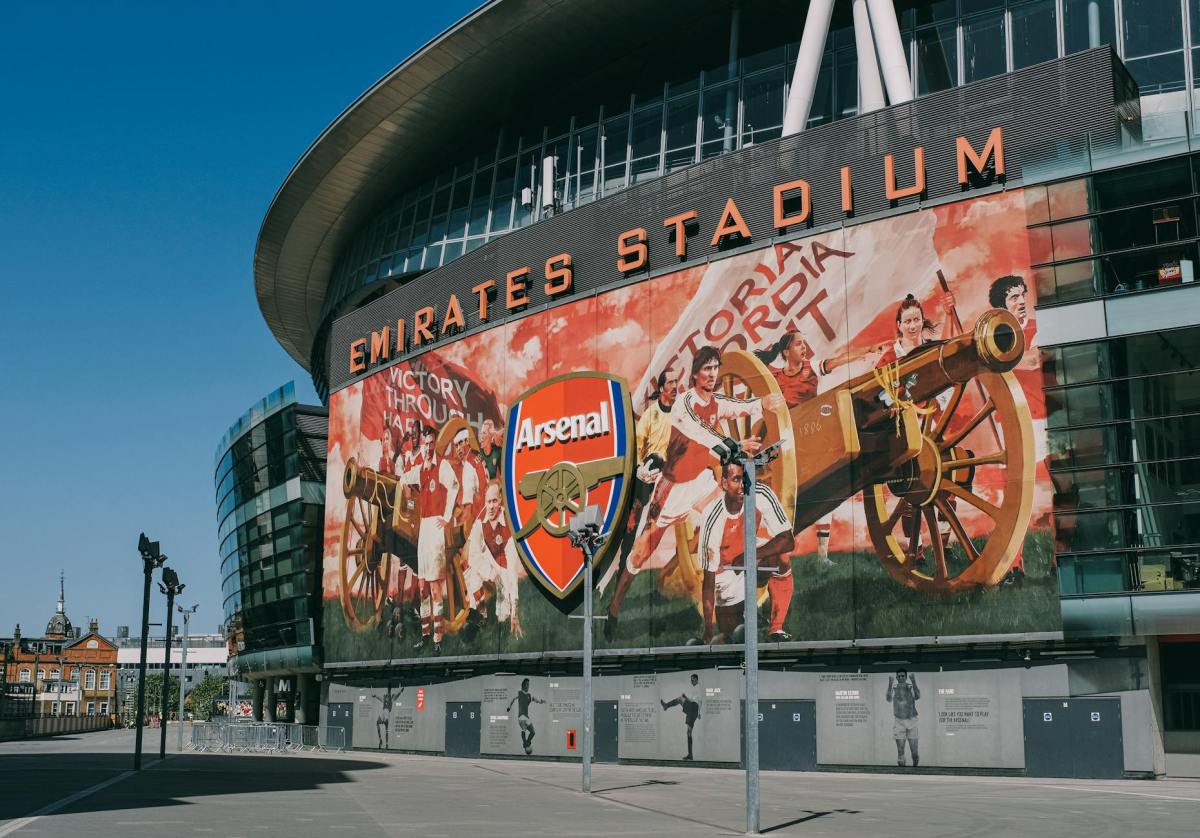
A meme of social media banter may have been born when the Manchester City fan, Tal Rehman, went viral during a 0-3 win against Chelsea at Stamford Bridge in April, but even the most viral internet memes are soon overtaken by a collusion of circumstances, reanimating the algorithmic reproductions of football and its fan culture. Rehman, who was captured by television cameras mockingly drinking from an Arsenal-branded water bottle at Stamford Bridge, eventually congratulated Arsenal for their Premier League title, telling Sky News that his famous “bottle prank” was all banter, produced by the exhilarations of a fan “just messing about with my son.“
In the spirit of banter’s oppositional dialectics, and in light of Arsenal’s reclaiming of the EPL trophy after a 22-year wait, Arsenal’s Eberechi Eze appeared to confirm the archive of online memes and mockeries of his London club was all banter, and “part of football,” but he too could hardly hold back the mirth of his counter-bantering jibes, sharing an image of Rehman as a blue, bloated bottle, used as a display picture on Instagram. Other comic variations of the reverse bottle meme were shared widely by Arsenal fans on the last day of the season, along with the images of the EPL trophy itself. How is one to make sense of these geographies of banter, especially the laughter, the ironies, the tensions they summon across digital cultures, if not through the lens of cultural theory? Particularly through the ideas of French philosopher Roland Barthes and the Russian literary theorist Mikhail Bakhtin, what appears on the surface as an unserious popular practice reveals itself as something far more charged.
Banter may occasionally yield to bullying and other online vices, but stripped of that odious tendency, there’s a cultural politics it encodes that recalls Barthes’s arguments in Mythologies, especially how myths as systems of communication naturalize forms of domination. Signifying something other than mere teasing and pranks, then, banter reveals a mythic quality that renders natural the domination of algorithms and platform capitalism over the human sensorium, something artificial intelligence systems now appear to complicate. For those interested, like Barthes, in how mass culture transforms everyday ideas into seemingly unquestionable and natural truths, banter’s cooptation for the logics of big tech is resonant, having a mythological tenor that signals something beyond the dressing room, or the game itself. There is, of course, nothing inherently insidious about curating social media banter for content engagement and monetization, but it is oftentimes precisely in these domains that fan mockery and pranking often surrender to the excesses of harmful bots and the agents of abuse and microaggressions.
In this Barthesian reading of football and its banter, then, the memes of online culture and other everyday objects, ideas, and symbols transcend the domains of semantic ordinariness into becoming a system of signifiers that, in the case of football banter and its parodic memes, invoke other meanings. The conviviality of Eze’s Instagram moment, with its sardonic laughs, is surely hard to miss, but it is the reimagination of the bottle meme itself, the iconic imagery of Arsenal’s EPL campaign in the Arteta era, that is most telling. If the many playful blasphemies and mockery now being aimed by Arsenal fans at their traducers online were biting, Eze’s teammate Myles Lewis-Skelly appeared to read the moment well, quipping excitedly on Instagram, “They called us bottlers, now we’re holding bottles,” a reference to the celebratory pop of the cork that greeted Arsenal’s deserved triumph.
In the case of the new champions of England, what makes the banter memes striking is not just their saturation of social media platforms, where they signal the globalism of Arsenal’s support base and the worldwide following of the EPL. One must now reckon with players who, besides dazzling us on the pitch, embrace the wisdom and unruly spaces of digital crowds, becoming active participants in the affective economies of online banter. While keeping in view the disturbingly perennial scapegoating and abuse of players on social media, the space also seduces players themselves to the social affordances of digital networks and pleasures. But there is also the fact that banter invites us to rethink the cultural value of football as one of several responses to the politics of exhaustion and cultural fatigue in the modern era.
If the football pitch were a beloved text composed by the sporting artistry and magic of eleven people on each team, banter offers an extra-textual modality for combating some of the encircling ugliness of the Beautiful Game. Not in the Marxian opium of the people sense, although there is a religiosity to fandom and sports followership writ large, but in the sense in which footballing banter becomes a way of negotiating the doldrums and miseries of a troubled planet. In a post-COVID world, still coming to terms with decreasing wages in many countries, and continuing war and conflicts in different pockets of the world, football, with its fields of banter, comes to signify something beyond the game, including the human aspiration for meaning amidst the chaos around us. As the People’s Game collects people from disparate cultures and societies together, laughter as a vocabulary of banter is often the organizing logics of their communion. Conceived on Instagram and X/Twitter as a playful rivalry after the melancholia of defeats, or following the triumph of a winning goal, banter excavates the pleasures of the soul in a world of dreariness and anxiety.
Any echoes of the Medieval understandings of European festival laughter here come from Bakhtin, whose view of laughter shapes how popular humor is sometimes read today. As Bakhtin wrote in Rabelais and His World, we always find in laughter “the defeat of fear presented in a droll and monstrous form, the symbols of power and violence turned inside out, the comic images of death and bodies rent asunder. All that was terrifying becomes grotesque.”
For some Arsenal fans, waiting over two decades becomes the fodder for self-deprecating humor, and for the club’s rivals, that delay has, over time, produced a collection of memes and grotesqueries that now define the club’s identity. But it is only through banter, like Medieval laughter, that we might gain access to some essential vistas of the world otherwise illegible to us. As Bakhtin might have argued, social media banter possesses deeply philosophical meaning and manifests as an indispensable expression of fandom that lays bare the contradictions of our current history. In short, we can hardly envision the vibrancy of fan communities today without the riotous idioms and witty clapbacks of online banter supplementing the intensities and aura of the most electrifying stadium atmospheres with the rumbustious verbal arts of banter.
Yet, banter is hardly a homogenous rhetorical practice, as it takes different shapes around the world, with the memes of its virality configured by the granular flavors of local aesthetics. In Nigeria, where the club has one of their largest and most passionate support bases outside of the UK, the Arsenal bottle meme, for example, is the most benign form of banter you may find online. There are simply bigger fish to fry, with the name of the club itself often synonymous with the undesired and the eternally prologued, such as a delayed marriage proposal, or even waiting endlessly for the local power grid to function effectively. In what would have been a surprise to Arsenal’s “Bible Brothers,” the close-knit group of Christian players in the squad who gather before every match to study the Bible, one Nigerian preacher (Pastor Dolapo Lawal) even went viral in April 2026 when he stated that Arsenal was “cursed” and would never win the league, while advising women not to date any Arsenal fans because they were losers. All that changed after Arsenal secured the trophy following City’s defeat to Bournemouth, forcing Pastor Lawal to release a video apology to which Nigeria’s throng of Arsenal fans, intoxicated by the wine of regained success, countered with the rhetorical inventiveness of their retaliatory banter. What appears to vex them the most is not the failure of a prophetic utterance but how banter, in this case, intertwines with the profanation of the sacred, something Bakhtin would have been familiar with.
At stake here is banter’s capacity in this West-African milieu to enact the social and political axes of authority as intensely contested and refuted. Aside from religious leaders, there are other instances of this dynamic. The Ghanaian MP and opposition lawmaker Isaac Adongo who, during a parliamentary debate on the budget in 2022, compared his country’s economic mismanagement with Harry Maguire’s on-pitch performance for Man United, is another good example of how banter performs a discursive function that scripts laughter in the face of power. Maguire, an avid social media user, would later accept the MP’s apology after Adongo referred to him as “a transformational footballer… now scoring goals for Manchester United.” For both men, despite the occasional digital ambiguities and dramas of online banter, there is a shared understanding that it is without malice and may, in fact, activate social bonds.
Beyond the global and vernacular dimensions of its transnational circulation, though, what constitutes the normativity of religious power or prophetic and political proclamations in such local spaces is renegotiated by fans for whom football presents not just a distraction from the drudgery of quotidian life but also an opportunity to challenge the hegemony of the ruling elite. In the meantime, what cannot be sensibly contested is that for Arsenal and their fans in the UK and elsewhere, the emotions of the present moment and its banter can hardly be bottled.
With the FIFA World Cup starting in June, the banter shifts from the club level to a nationalistic domain in which the registers of banter are dressed in other kinds of garbs. In that international forcefield, the laughter and the memes operate in different systems of subversions, presenting a second-order system of meanings in which national mythologies and geopolitical histories are the dreams of banter’s fantasies.


Excellent piece! The insights here really capture the drama and excitement of the competition. Thanks for the thorough analysis!
LikeLike