Game on, Nollywood! On Aki and Pawpaw Epic Run

Aki and Pawpaw’s epic run in the first Nollywood-inspired game expands the scope of African popular culture and its convergence with digital media.

Yet another textual form produced by the impact of digital media on Nollywood films is the videogame. I have already discussed previously in my book Cultural Netizenship how internet memes, GIFs and other aesthetics of social media aesthetics demonstrate an intermedial convergence between Nollywood and other media assemblages. The point of that earlier work is basically to think about how platform culture shapes the ontologies of African popular arts. You know Nollywood is a global brand not only because its best films now travel to major film festivals around the world but also because its images and scenes consolidate their famed entrance into the flow of global media culture through its unabating supply of internet memes and narratives.

But beyond the transnational opportunities streaming platforms like Netflix now provide people around the world to consume Nollywood films, there is also the visibility of Nigerian films among a playful commentariat on the internet some of whom rely on Aki and Pawpaw memes for their everyday online communication. With real names Osita Iheme and Chinedu Ikedieze, Aki and Pawpaw are two diminutive actors who often played children characters in Nollywood movies many years ago.

For those of us who grew up watching the home videos of the 2000s, the story of two rascally boys who were essentially a menace to their community was quite a filmic encounter not to be forgotten. I am talking specifically about the 2002 comic film Akin na Ukwa in which Aki and Pawpaw were first introduced. Two decades later, a remake of this movie, eponymously titled Aki and Pawpaw began streaming on Netflix, with both troublesome brothers relocating to Lagos and angling for social media fame after meeting a dishonest online influencer who profits off of their talents.

With a new mobile game featuring both Nigerian actors becoming available on Google Play stores in the first quarter of 2023, Nollywood’s convergence with other media forms, it appears, continues to bear the distinctive marks of Aki and Pawpaw. Developed by Blueportal the first Nollywood-based mobile game, Aki and Pawpaw Epic Run mimics the aesthetics and goals of popular running games (like Temple Run), as the main player runs away from trouble using mainly either Aki or Pawpaw as avatars.

To gain points, they overcome challenges throughout the duration of gameplay while encountering different obstacles that hinder their escape. The gamer runs to avoid several assailants including a street vendor, a street urchin, and a masquerade. But, curiously, its message appears to be that something nefarious in Lagos keeps you endlessly running and panting. Even a masquerade, an otherwise significant symbol of African religious traditions and cultural performances, is problematically presented as a danger from which one must flee. A certain demonization of indigenous aesthetics animates the plot of the game, it seems. At this thematic level, the game can immediately be imagined as extending Nollywood’s abiding fascination with urban processes, especially in the city of Lagos. While the game is fascinating for its exploration of urban locations in Nigeria, that it articulates a particular, troubling image of the city aligns with Nollywood’s atypical portrayal of stereotypic narratives about everyday life in Nigeria as a hellish experience to avoid. It is like the game is bent on presenting Lagos as, to use the title of Nigerian novelist Toni Kan, a carnivorous city that devours people through crime and violence. There are, of course, many troubling realities in Lagos and other urban spaces in Nigeria, but that is just one aspect of the narrative.

We can look past this dimension of the game and commend its developers for reminding potential consumers that people play in Africa. At the same time, one also gets the sense that it ironically undercuts an African agency by depicting the experiences of its Nigerian characters as people constrained by tales of woes and troubles from which they have to escape. I can’t but think Aki and Pawpaw, like many in Nigeria today, would japa and leave the country if they could.

But these contradictions also generate the game’s promises as a valid expression of African popular culture. Video games as digital genres work as interactive and alternative digital objects intended through their design and aesthetics to convey specific narrative experiences based on user interactions. There are many creators of video games in Africa that present visual narratives which open aesthetic windows into the African predicament. From multiplayer games on Boko Haram to games that portray African farming practices, the video game is a significant aspect of digital culture in Africa and we need to do more to ingratiate ourselves as scholars to the scholarly provocations it activates.

Besides being an important aspect of a culture industry that is yet to be fully theorized in the Africanist context, it is an excellent instantiation of how new digital objects build on the mobile phone revolution in Africa to document and express quotidian realities. Here, I can think of another Nigerian mobile game Sambisa Assault, created by Chopup, a company that promises to give the world games that tell the African narrative. The combat game is based on the insurgency of the armed group Boko Haram and has players hunting down members of the armed group in their jungle stronghold. Players have a gaming experience through which they participate in a virtual battle with the terror group, killing and disarming them around the Sambisa forest. This was at a point when Boko Haram constituted a menace in Nigeria.

If Wakanda’s Afrofuturist world in Black Panther constructs a solution in Nakia’s secret missions for terrorist activities in Northern Nigeria, Sambisa Assault puts players in the line of fire. I realize the aim of the game creators, to get users to “save our city” by taking on the terrorists, seemed utopian. Like another plastic experiment that remained in the ether. But I think the game enabled pertinent analyses of the social impact of fictional narratives and media discourses on the coverage of the Boko Haram terror, propelling us to examine the relevance of gaming to the media coverage and representation of terrorism.

In Sambisa Assault, we can focus also on the representation of terrorists as othered subjects, enemies to be killed and annihilated, but the game also invites us to think about questions of mob justice and what it means for citizens to take up arms against violent social actors. Along with Aki and Pawpaw Epic Run, the game is another fascinating example of how digital platforms enable digital storytelling as another aesthetic mode by which people now respond to social and political issues in many parts of Africa. While it is true that they are texts of pleasure and entertainment that often get caught up in the debates about gun control and violence in the US, video games, as one sees in Aki and Pawpaw Epic Run, are indeed sites of social meanings and political ideologies.

In addition to these two games, and beyond the Nigerian digital ecology, there are more sophisticated video games that focus on sociopolitical issues from other parts of Africa. For instance, at some point, the Ugandan video game developer Lual Mayen offered a preview of the game “Salaam” which, like Samba Assault is focused on social impact. Based on his life as a refugee, the mobile phone game gives players the opportunity to take on the identity of a refugee who escapes a troubled area or conflict zone, even as they strive to survive by gathering food and medicine while also running away from violence.

This video game allows players to develop empathy for refugees, connecting a new media form with the immigration politics and anti-refugee populism being witnessed around the world. By examining how games like this, as well as Sambisa Assault, and Aki and Pawpaw Epic Run manifest as symbolic texts of digital culture in Africa, the task of a more extended analysis will be to reflect on some of the ways by which the game industry in places like Nigeria remains underdeveloped. A more solid industry has the potential to strengthen scholarly and public discussions on the poetics and politics of digital media more generally in Africa.  

For Aki and Pawpaw Epic Run, it might be useful to close by adding that the game gives Nollywood audiences another kind of experience of two of the industry’s beloved characters. At the same, it is playing on nostalgia by reconnecting audiences back to an era of Nollywood that is far gone, one that offers a counterpoint to the current realities of the moment. This tendency is common in forms of popular culture, but it is probably the first time in Nollywood gaming has been recruited as an entertaining affordance to bring back the past. The design and graphics of the game might not be anywhere near the industry standards, but it is another step further in the Nigerian creative industries.

Social Media Skits and the Shadow of Nollywood

A scathing review of the political comedy Your Excellency, by Funke Akindele, written by an anonymous critic describes her directorial debut as a bunch of Instagram skits and not a movie. Rather than encountering ‘an amazing political comedy’ that satirizes Nigeria’s practice of democracy in a digital era, the audience, according to the anonymous reviewer, is made to endure ‘a string of Instagram skit videos, retinue of unnecessary actors and underdeveloped characters.’ This review embeds an implicit derogation of Instagram skits because they are not seen as professional or standard filmic practices, signaling attention to the conceptual dimensions of the argument that a Nollywood film is merely a pastiche of Instagram videos. Yet, the Instagram skit (or simply social media skit, since these works circulate from and to several other platforms like TikTok and WhatsApp) has emerged as a new digital genre of Nigerian humor produced and circulated online for social media users targeted as fans and followers.

With superb performances by comedians who deploy humor as the means of interpreting local experiences for social media’s transnational audiences, the structure of the Instagram skit as a short text is based on few characters and a condensed plot that evolves over a short time span, usually between one to three minutes. A recurrent element of most texts of Instagram comedy is the sonic appropriation of soundbites from previously viral videos, such as Patience Jonathan’s famous “Okay continue” line. As these new digital genres of popular culture proliferate in recent years because of social and digital media, the prosthetic relations between comic videos that circulate on social media and the Nigerian film industry recall some of Nollywood’s most enduring subject matters and production dynamics.

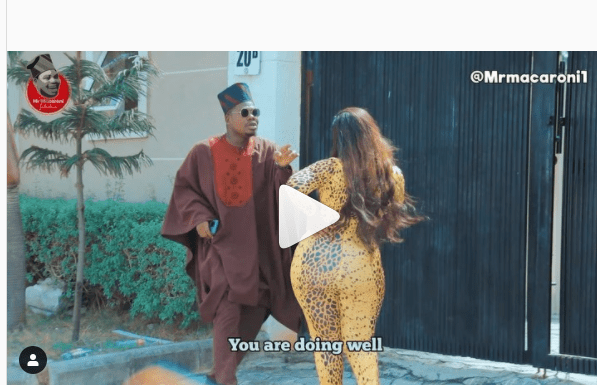
#EndSARS, for instance, presented an opportunity to read the violence of police brutality through the pseudo-cinematic texts produced in real time by several online comedians, including Debo Adebayo (@Mrmacaroni1), who documented the youth-led outcry against a dominant state repressive apparatus in their jokes. @Mrmacaroni1, who was later arrested at the now-infamous Lekki tollgate, also recorded his own encounter with the police in another series of skits that make legible the integration of social media affordances into the production of online stories against state domination. One of the major highlights of #EndSARS from the perspective of @Mrmacaroni1’s comedy is the convergence of the activistic and the artistic. Like the music of protest during #EndSARS, the real-time skits created by @Mrmacaroni1 to comment on the protest and invite more supporters online are significant aspects of the archive of narratives and images produced on the movement.

Although online social movements are not always examined in terms of the artistic practices that underpin and supplement them, the comedic texts of #EndSARS set up the conditions under which we may begin such engagements. This deliberate politicization of popular cultural form such as Instagram comedy, or the circulation of creative practices and activities on the internet for the purpose of resisting hegemonic power structures and ideologues is what I am describing as cultural netizenship in another work on social media-enabled popular performances in Nigeria. Unlike the normative performative signals of netizenship as an expression of Net citizenship, cultural netizenship evokes the deployment of visual and popular culture online to push back at oppressive power. But Cultural netizenship goes beyond humor and points to other regimes of visuality such as the creation of memes that foreground the remediation of Nollywood images for performative self-expressions online.

But as scholars like Jonathan Haynes and Akin Adesokan have shown, Nigerian popular representations have historically offered a terrain for the construction of politics. From Ola Balogun to Tunde Kelani, the genre of the political film in Nollywood is well established and enjoys considerable analytical exploration in Haynes’s 2016 volume on Nollywood. Gbenga Adewusi’s 1993 film Maradona (or Babangida must go) tackles the annulment of the 1993 presidential elections by General Ibrahim Babangida. For those who do see no connections between Nollywood and protest culture, films such as Adewusi’s offer some solid evidence. @Mrmacaroni1’s comedic videos continue this subversive tradition by rendering Instagram comic texts as reconstructions of the political. Hence, the crucial need to explore the discursive role of the social web in Nollywood’s political genre. Funke Akindele’s representation of social media in Your Excellency brilliantly offers a cinematic construction of Nigerian digital culture, showing Akindele’s previously savvy use of the platform to distribute film narratives. The #Laburuchallenge, which trended in 2021 after Netflix announced a second instalment of The King of Boys is one way the social web is shaping audience behavior and Nollywood films consumption while exhibiting the growing aesthetic interrelations between New Nollywood films and social media platforms.

Aside from the political uses of Instagram comedy, the production of these videos is similar to the do-it-yourself culture that inaugurated Nollywood, while the industry’s famous commercialism is a neat pretext for the widespread aspiration for commercialized artistic practices among Instagram comedians. Like early Nollywood, with its absence of big budgets and high production values, many of these comedians basically took narrative power in their own hands by grabbing a camera and shooting a viral, to borrow Kanye West’s lyrics from Power. The number of people who follow online comedians is vital and ultimately means that the skits produced by popular names such as @Taaooma (Maryam Apaokagi), @Officerwoos (Oladaposi Gbadamosi), and @Broda Shaggi (Samuel Animashaun Perry) eventually serve the logic of capital. For instance, @Mrmacaroni1 recently celebrated reaching 1 million followers on Instagram. The inference we may draw from this is not just about the much-coveted numbers many social media influencers crave; it is also how the circulation of comic narratives is contingent on the shared participation of audiences that are invited in post-narrative commentaries that request them to “share or subscribe for more videos.”

With huge unemployment figures in Nigeria, Instagram skits serve as an entrepreneurial deployment of popular humor and reveal the capitalist transformation of online speech and agency into monetary opportunities. The Instagram skit implements a commodification of humor projected through narratives that both serve advertisers and entertainment, as the huge audience of the Instagram comedian is recognized by corporate patrons who commission skits that advertise products. This way, the production of Instagram skits is both an expression of digital speech and humour and, in more significant ways, a reiteration of the neoliberal logic of both Nollywood and the social media platforms that profit from the digital labors of users. Hence, Instagram comedy presents an excellent illustration of the commercialization of creativity that most animates the artistic practices of performers who started out as playful netizens on social media.

The many Nollywood stars who increasingly appear in these skits also consolidate the important linkages between Nollywood and social media texts of comedy, even as these characters feed off the influence economy from each other’s sectors, with Instagram comedians also featuring more prominently in new Nollywood movies. Thematically, although several of these comedians later explore other social issues, some of them abidingly retain perennial themes and style. For instance, @Taaooma makes skits that portray everyday realities, which focus on mother-daughter conversations in Nigerian homes, but her comic style reinforces the stereotype of the so-called African mother as an inherently violent person who forbids the agency of children. This is, of course, not limited to @Taaooma. There are many other comedians, especially from Nigerian diasporic communities, who project these single stories of African parents.

For his part, @Mrmacaroni1’s “Daddy Wa” character is a philandering agent who derives pleasure from the sexual objectification of women, although some would argue he merely uses this didactically to critique marital infidelity. Like the problematic depictions of women in Nollywood itself, which dates back to earlier androcentric representations of women in earlier popular forms such as Onitsha market literary pamphlets, @Mrmacaroni1’s skits depict women as materialistic subjects who depend on men and their money. While the men in these skits are often represented as wealthy and successful (in the case of Daddy Wa), women are consistently portrayed as sex objects who exist for the male gaze and pleasure. There is an enormous body of work on this trashy representation of women in Nollywood, and several texts of Instagram comedy essentially rehash these ideologies, centering Nollywood as the dominant form of Nigerian popular culture.

Stereotypical representations aside, Nigerian online comedians are creating some of the most assured work on social media and are quickly perfecting a new genre of humor that invites us to imagine genealogical links between Nollywood and comedic practices on the participatory web. If Nollywood films dramatize the lives of everyday Nigerians faced with the postcolonial condition, the industry now has a shadow cultural economy that both ‘competes’ with it and strengthens it.

Interested in reading more?

Here is a chapter from my book, Cultural Netizenship: Social Media, Popular Culture, and Performance in Nigeria, in which I explore this topic in relation to digital humour, the politics of virality and children’s comedy, and how skit-making cultures create what I describe as “economies of influence.”