A slightly different version of this article was first published by Olongo Africa.
At the Prince Moulay Abdellah Stadium during the 2026 AFCON final, Morocco’s Brahim Díaz attempted something almost unheard of in the 68-year history of the Africa Cup of Nations: a Panenka penalty. Rather than diving early as the technique’s logic dictates, Senegal’s Edouard Mendy chose to stay put, unmoved by the vociferous roar of the home crowd. As the ball arced gently towards him, Mendy arrested the deception, catching the ball, much to the delight and euphoric cheers of the Senegalese contingent in the stadium. Except for Zinedane Zidane’s cheeky chip in the 2006 World Cup final, a Panenka is rare in any high-stakes final; at AFCON, it is virtually nonexistent, a fact that makes this particular gamble in an already controversy-laden match all the more remarkable. With disputed refereeing decisions and a chaotic 17-minute walk-off protest by Senegal on its heels, Diaz’s Panenka was a performative act that felt iconic in the history of the beautiful game. Whether intended to bring calm to chaos or crown his stellar tournament in refulgent style, the Real Madrid forward reminded fans that beauty and tragedy are inseparable when we gamble on grace over certainty.
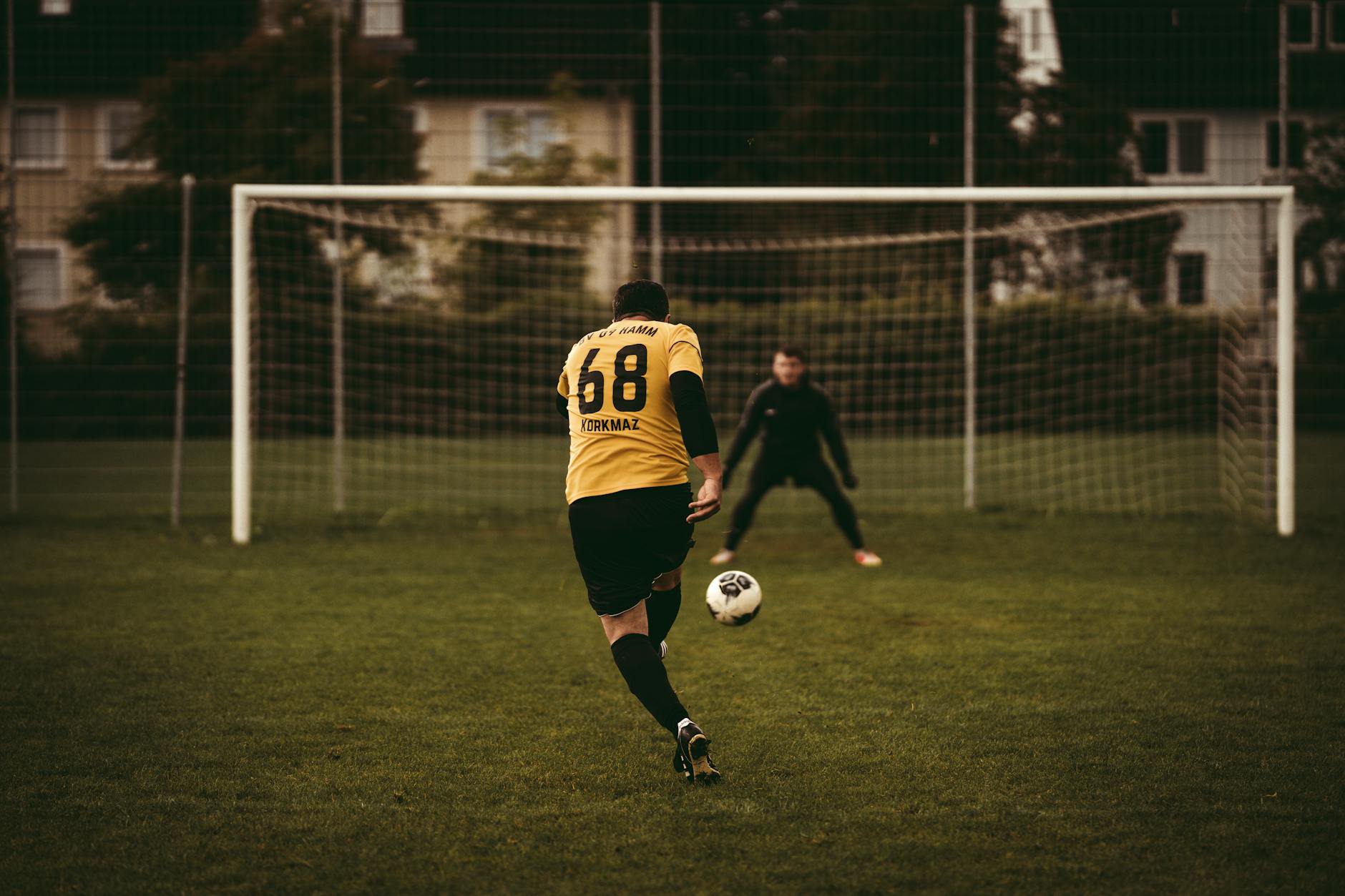
Historically, the Panenka comes to us from the exploits of Czech footballer Antonín Panenka, after whom it was named. He attempted it for Czechoslovakia in the 1976 European Championship final against West Germany. The idea is to prioritize the gentle chip of elegance over the familiar force of the spot kick, gently dinking the ball into the center of the goal as the goalkeeper thinks you’re aiming hard for one of the corners of the goalmouth.
The word ‘panenka’ in Czech literally means “little doll” or “puppet,” contains a suffix (-anka) that transforms the base word panna (young girl/maiden) into an affectionate, smaller form. The word panenka is itself a diminutive, giving the move its characteristic sense of softness and delicacy, which linguistically mirrors the physical execution of the penalty as a soft and gentle chip rather than a forceful strike. Antonín Panenka’s clever execution was so elegant that France Football called him “a footballing poet,” a sentiment echoed by Pelé, who remarked that anyone “who takes a penalty like that must be either a genius or a madman.” But there are certain elements of a perfect Panenka, as Antonin Panenka himself would later describe it in an interview with Ben Lyttleton:
The main ingredient is to do with your own behaviour – your body language and your eyes – to ensure the goalkeeper doesn’t think that you want to kick the penalty in a different way. My run-up was always longer to gain a bit of extra time; and faster so the goalkeeper doesn’t have a chance to change direction.
The shot should not be too fast, you have to chip the ball so it glides. Also you have to send the ball directly to the centre because even if it is one metre from the centre on the right or left, the penalty loses its beauty. When the ball is crossing the line, it should be already dropping. Even better if the ball reaches its peak height before the goal-line and then goes down.
In defiance of its technical brilliance, the Panenka sculpts its own narrative by going against the grain of penalty conventions; it reconfigures nonchalance and its slow, cheeky casualness into a delicate yet creative force that delights the senses. Framing the Panenka in these artistic terms means we can appreciate it as a sublime gesture of bodily skill on the soccer pitch, effecting an aesthetic spectacle whose greatness crystallizes in the instant the goalkeeper dives the wrong way, and the ball crosses the line. Our sensory encounters with such a beauty, or our perception of it as an artwork in the immediacy of the penalty moment, produce an emotional intensity, an affect that rings across the supporters’ stands and echoes in the language of the most electrifying commentary.
In the sense described by the Romantic poet John Keats, Díaz’s Panenka penalty might be said to have generated a negative capability for fans who, during that AFCON finale, watched the Panenka moment while suspended between hope and dread, unable to resolve the unfolding tension until the ball dropped in the safe arms of Mendy. From the letters of Keats, negative capability describes “when man is capable of being in uncertainties, Mysteries, doubts, without any irritable reaching after fact & reason.” Logic and reason may fail any attempt to account for the nervy seconds leading to the penalty or why the safety of the power-shot offered no seductions, but the audacity of Díaz’s penalty, mirroring that of legends like Lionel Messi, Zinédine Zidane, Francesco Totti and Andrea Pirlo, suggests that, with the penalty taker – much like Keats’ great poet, “the sense of Beauty overcomes every other consideration, or rather obliterates all consideration.” For the spectator, the mystery of it all is confounding and the uncertainties of a fleeting footballing magic are rather satisfying. We don’t doubt what we have just beheld, but the fact of its risk befuddles us.
Keats might have written about the observer’s tolerance for ambiguity in his letters, rather than the mindset of those in an athletic event; yet there is something about the poetry of the moment he might find familiar, particularly as logic surrenders to the sensational triumph of feeling and imagination as the Panenka demands. Indeed, Keats wasn’t alone in this approach to poetic beauty. Edmund Burke, for his part, contrasted beauty with the sublime, arguing that the passion caused by something truly great is astonishment, “that state of the soul in which all its motions are suspended, with some degree of horror.” This moment of performing the Panenka, when time stands still, and awe and wonder seize the observing spectator, is similarly one of horror, presenting a free play of beauty and horror enacted at once. Seen through Burke’s analyses, Diaz’s miss isn’t just a dagger to the heart of a nation; it manifests the darker edges of the sublime.
Beyond Burke’s sublime, the Panenka also transcends the thresholds of extreme confidence and signifies the human propensity to impose order on the chaos of existence, to find splendor in the intensities of competitive life. Its significations go beyond football, then, as it represents our need to choose the poetic arc over the pragmatic force. The Panenka comes to symbolize our quest for agency in an uncertain universe that doesn’t always follow our scripts. The poetry of the Panenka, like the verses of the Romantic age, shapes football at a deeply sublime level, but this inclination for beauty often courts tearful horrors like a fan’s agonizing reaction to the brilliance of a missed chance that eliminates their team.
Those seconds leading up to the Panenka are indeed bound up with thoughts colored by the likelihood of failure and the possibility of spectacular success. What a player does at that point is not only a function of their mental fortitude but also of our need for control. As both a curse and a blessing, a duality Díaz discovered firsthand in Morocco, the Panenka manifests our natural inclinations to enact the struggles of everyday life from a place of optimism. And the fact that this hope can either kill a nation’s eternal wait for another AFCON trophy, as in this case, or produce the kind of climactic brilliance he ventured is what makes the Panenka distinctive as football’s quintessential gamble.
There are probably other meanings to Díaz’s Panenka. It may have been intended to humiliate Senegal and inflict a psychological wound, but its horrible failure both left the striker distraught and exposed the perils of a delicious skill. And I am not suggesting here that the Panenka is inherently disrespectful; rather, in its manifested ambiguity, we see ourselves in the beautiful risks that repulse the opponent, and the risky beauty that none of us can resist. What was supposed to be an assured statement of psychological dominance in a fraught and thrilling encounter became an account of how the desire for control can often be messy. Only a select number of players have dared the Panenka in major finals. The fact that Díaz chose a crucial moment of Africa’s most prestigious tournament, with Morocco’s 50-year trophy drought on the line, and in front of a home crowd, only amplifies the risks that come with Panenka’s gamble.
Perhaps its failure even had unintended benefits. Nigerian journalist Ayomide Oguntimehin, present in the stadium, suggested that the miss may have diffused the fury and tensions in a volatile atmosphere, sparing African football from disaster. Whether or not this is true, the moment’s complexity, simultaneously tragic for the host nation and relieving for Senegal, who went on to lift the trophy after a 1–0 scoreline, only reinforces the Panenka’s essential ambiguity as a delectable skill that offers both salvation and, in Díaz’s case, suffering. Indeed, an AFCON Panenka is an exceptional occurrence – in fact, very few, if any, are documented – and that is not because African players lack any technical ambition compared to their counterparts elsewhere. Yet its now-famous failure at the 2026 final signals more than the artistry of a special technique. It reminded the world that a Panenka’s vulnerability is at the same time football’s most human moment, defined by beauty inextricable from risk.
When Senegal’s Mendy caught that ball that night, he didn’t just save a penalty in the most stoic display of composure, he preserved the Panenka’s fundamental paradox, denying the victory of its poetic graces. By staying still, Mendy essentially became the critic who refuses to be seduced by the poet’s aesthetic maneuvers, rewriting the grammar of a heated moment for pragmatism. Had it succeeded, handing Morocco its first AFCON trophy since 1976 (the year we first learned of Panenka, both the man and his skill), we would remember only Díaz’s audacity – more so because the same technique which birthed what many might call Morocco’s greatest footballing joy when Achraf Hakimi pulled off a Panenka to eliminate Spain at the 2022 World Cup in Qatar became the source of its greatest heartbreak in 2026.
The paradox of this tragic symmetry couldn’t be more textured. In the crushing failure, we’re reminded that Panenka’s beauty lies not in any fantasies of certainty, but in its necessary risk. Every Panenka contains the possibility of this, with a ball either caught by the keeper or sailing home, and a daring player either shattered or ecstatic. Ultimately, we are confronted with a technique that can be both sublime and fragile, more like the human ambitions it so quietly represents. To contemplate the Panenka, therefore, is to behold beauty and embrace its inherent messiness and contradictions.




 James Yékú